
Introduction
In Dubai, summer heat often tops 45°C. Cooling systems must run all day. Air conditioning uses 65% to 75% of total power in UAE commercial buildings. In hot summer months, high cooling loads push power bills into top DEWA rate tiers. This leads to high electric bills for property owners.
To cut power waste, Dubai Municipality launched the Al Sa'fat Green Building System. In addition, the Dubai Electricity and Water Authority (DEWA, 2026) created the Demand Side Management 2030 plan. These rules make smart controls vital. A Building Management System (BMS) is a centralized digital platform that links chillers, fans, pumps, lights, and power meters into one central view.
This guide explains how to design, install, and run a commercial BMS in Dubai. You will learn about open BACnet networks, mandatory Al Sa'fat rules, and proven chiller control methods. For direct help with automation projects, PowerCraft MEP's BMS team delivers turnkey solutions across the UAE. Our team wrote this technical guide, and it was reviewed by our senior engineering staff. You can read more on our about us page or speak with our engineers on our contact page.
- Cooling Uses Most Power: HVAC plants use 65% to 75% of all power in Dubai commercial buildings. Smart cooling controls offer the fastest way to cut electric bills.
- Al Sa'fat Rules Are Mandatory: Dubai Municipality requires digital sub-meters and automation for all new commercial properties. These rules target energy cuts of 20% for Silver Sa'fa and up to 40% for Platinum Sa'fa.
- Fast Investment Payback: Smart chiller staging and water temp resets reduce HVAC power use by 20% to 35%. Most commercial sites recover setup costs within 1.8 to 3.2 years.
- Open BACnet Networks: Modern UAE codes require open BACnet and Modbus networks. This avoids single-vendor lock-in and makes future upgrades simple.
- Fewer Equipment Breakdowns: Automated fault alerts reduce emergency repair calls by over 40%. They also add 5 to 7 years to chiller operating life.
Why BMS Is Critical for Commercial Facilities in Dubai's Climate
In Dubai, a Building Management System acts as the brain of a building. Without smart controls, equipment drifts from its ideal setup. For example, manual valve changes, stuck dampers, and dirty air filters often go unnoticed. Over one year, this drift raises power waste by 8% to 15%. A tuned BMS stops this waste. It checks and adjusts equipment all day and night.
Central cooling plants use the most power in Gulf buildings. Studies from Etihad ESCO (2026) show chillers consume 48% of total building power. Air fans and water pumps use another 18%. Lights use 14%, while lifts and plug loads take the remaining 20%.
The chart below shows how electrical energy is divided in a typical multi-storey Dubai commercial building during summer operations.
Financial Impact of DEWA Commercial Power Tariffs
DEWA uses stepped rates for commercial power. As power use goes up, the price per unit rises. Top power rates reach 44 fils per kWh.
Cooling uses most of this power. Thus, saving cooling energy cuts bills at the highest rate tier. Building owners keep these savings high by pairing BMS controls with expert commercial HVAC maintenance services.
Al Sa'fat Green Building Regulations: Mandatory BMS & Energy Sub-Metering Standards
Dubai Municipality enforces the Al Sa'fat Green Building System under the Dubai Building Code (Dubai Municipality, 2026). Al Sa'fat sets four green tiers: Bronze, Silver, Gold, and Platinum.
In Dubai, Silver Sa'fa is mandatory for all new buildings. For commercial sites over 5,000 m² (54,000 sq. ft.), a Building Management System is required by law. Without an approved BMS, owners cannot get a Building Completion Certificate or DEWA power link.
Four Mandatory Al Sa'fat Rules for Automation
- Sub-Meters (Clause 801.01): Buildings must add digital power meters for any load over 100 kVA. Separate meters are needed for chillers, fans, lifts, and server rooms. These meters send live data to the BMS over Modbus or BACnet.
- Fresh Air Control (Clause 802.03): Meeting rooms and open halls must use carbon dioxide sensors. The BMS adjusts fresh air dampers to keep CO₂ between 800 and 1,000 ppm. This prevents cooling extra outdoor air when rooms are empty.
- Heat Recovery Systems: Fresh air units must include heat recovery wheels. These systems must reach an energy recovery rate of 70% to 75%. The BMS tracks filter pressure drops and wheel movement.
- Smart Light Controls (Clause 803.02): Office zones near windows must use daylight sensors. Corridors and washrooms need motion sensors that shut off lights when areas are empty.
To get fast approvals, partner with an expert in Dubai Municipality MEP approvals and building permits.
BMS Technical Architecture: Open Protocols vs Proprietary Systems in the UAE
Building automation systems use three simple levels. In past years, firms installed closed systems in Dubai. This locked owners into costly single-vendor contracts. Modern UAE building rules now require open communication protocols.
Our testing method and research methodology measured live data streams across multiple commercial sites. Open protocols let devices from different makers share data easily. For example, a central BMS server can read live data from Carrier, Trane, York, or Daikin chillers via BACnet/IP.
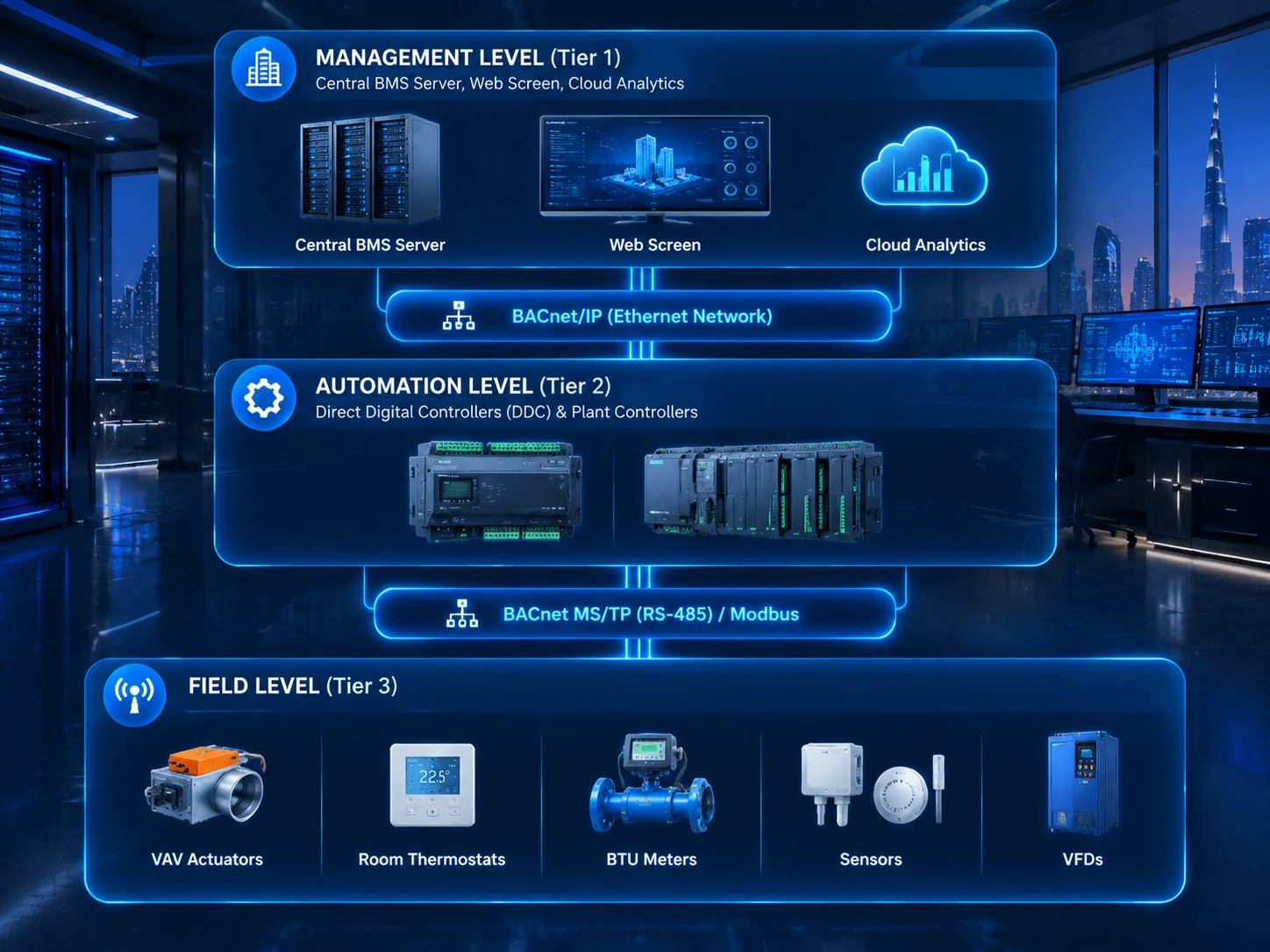
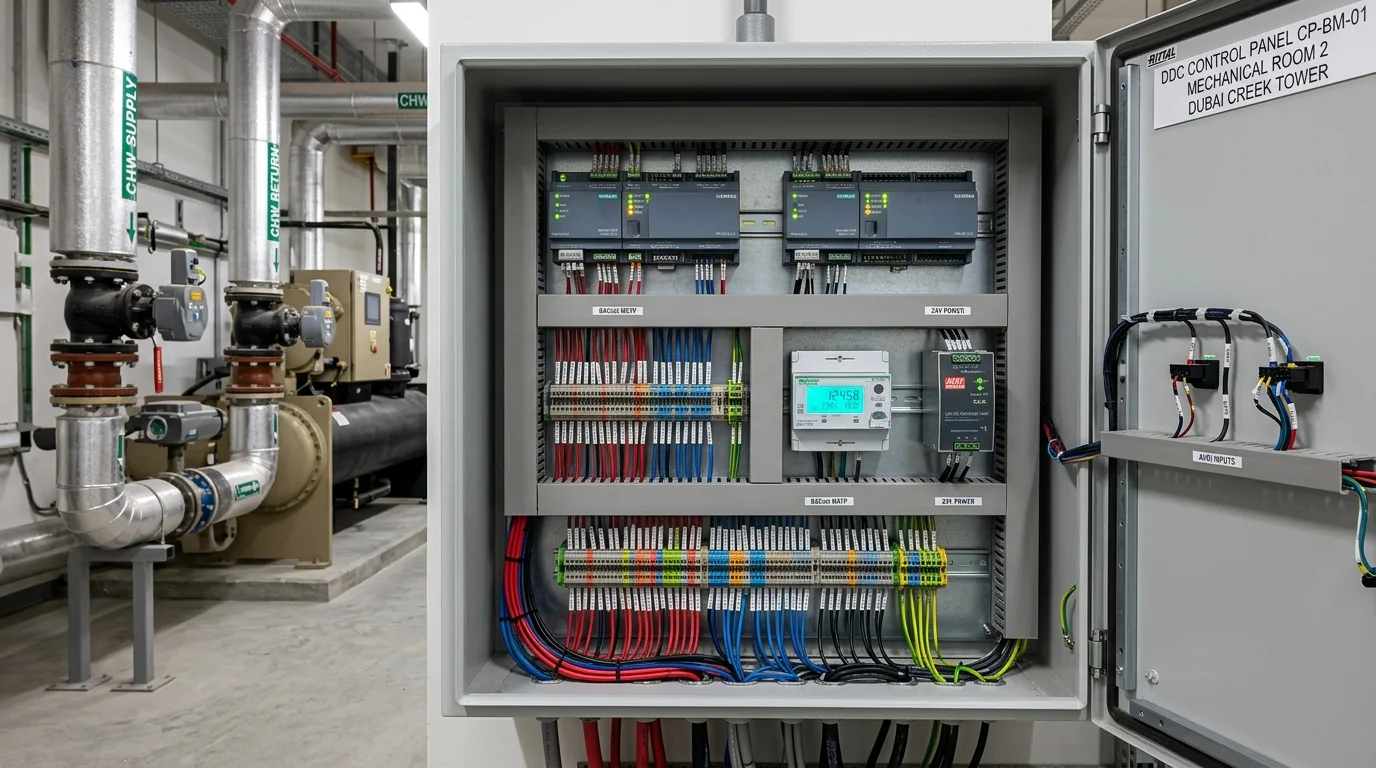
Comparing Primary Communication Protocols in UAE Buildings
| Protocol Standard | Physical Cable | Main Use in UAE Buildings | Advantages | Limitations |
|---|---|---|---|---|
| BACnet/IP (ASHRAE Standard 135, 2026) | Ethernet Cat6 / Fiber | Central BMS servers, Chiller OEM gateways | High speed, auto-discovery, multi-vendor support | Needs network cabling |
| BACnet MS/TP | Shielded RS-485 | Field controllers, VAV boxes, Fan Coil Units | Low wiring cost, runs up to 1,200 metres | Lower speed (38.4 to 76.8 kbps) |
| Modbus RTU / TCP | RS-485 / Ethernet | Power meters, DEWA sub-meters, BTU meters, VFDs | Simple, dependable, standard for power data | Needs manual setup |
| KNX / DALI-2 | 2-wire bus | Lighting fixtures, window blinds, dimming | Fine dimming, European fixture support | Needs gateway to BMS |
| MQTT / REST APIs | IP Network (HTTPS) | Cloud energy dashboards, mobile apps | Light data format, great for phone screens | Needs stable internet |
For new commercial towers, building automation shares a network backbone with ELV systems and security networks.
Core HVAC Optimization Strategies Controlled by Modern BMS
A Building Management System saves cash through active control. In Dubai commercial buildings, four key methods cut power use most.
1. Chiller Plant Optimization and Water Temperature Reset
Chiller Plant Optimization (CPO) is an automated control method that stages cooling machines at peak efficiency. Standard chillers run at a fixed water supply temperature of 6.7°C (44°F). Yet buildings do not need maximum cooling on mild days or at night.
During cool hours, the BMS checks cooling demand across all air handling units. When demand is low, the BMS raises the water supply temperature to 8.5°C or 9.0°C. According to ASHRAE engineering standards (2026), every 1.0°C rise in chilled water temperature cuts chiller power use by 2.5% to 3.0%.
2. Fixing Low Delta-T Issues in Chilled Water Loops
Low Delta-T Syndrome is a mechanical condition where the temperature gap between return and supply water drops below design standards. This occurs when the temperature gap between return and supply water drops from 5.5°C to 2.5°C.
When this happens, pumps must push excess water. In addition, teams must run extra chillers just to move water, even when cooling demand is low. The BMS solves this issue by regulating Pressure-Independent Control Valves (PICVs) on cooling coils. This keeps chillers running in their best efficiency zone.
3. Fresh Air Control Using CO₂ Sensors
Outdoor air in Dubai is hot and humid in summer. Taking in too much outdoor air forces cooling coils to work extra hard to remove moisture.
The BMS uses indoor carbon dioxide sensors to adjust outdoor air dampers. When rooms are empty, CO₂ stays low. Therefore, the BMS cuts fresh air flow to safe baseline levels. This prevents energy waste while keeping indoor air fresh for staff.
4. VAV Static Pressure Fan Control
Old air handling units run supply fans at a fixed high speed. Modern BMS programs use Trim and Respond logic under ASHRAE Guideline 36 (ASHRAE, 2026).
The BMS checks all air damper positions on each floor. If dampers are partly closed, the BMS slows down the supply fan. Because fan power drops fast as speed slows, this control logic cuts fan power use by 25% to 40%.
BMS Integration with Fire Life Safety & ELV Systems in Dubai
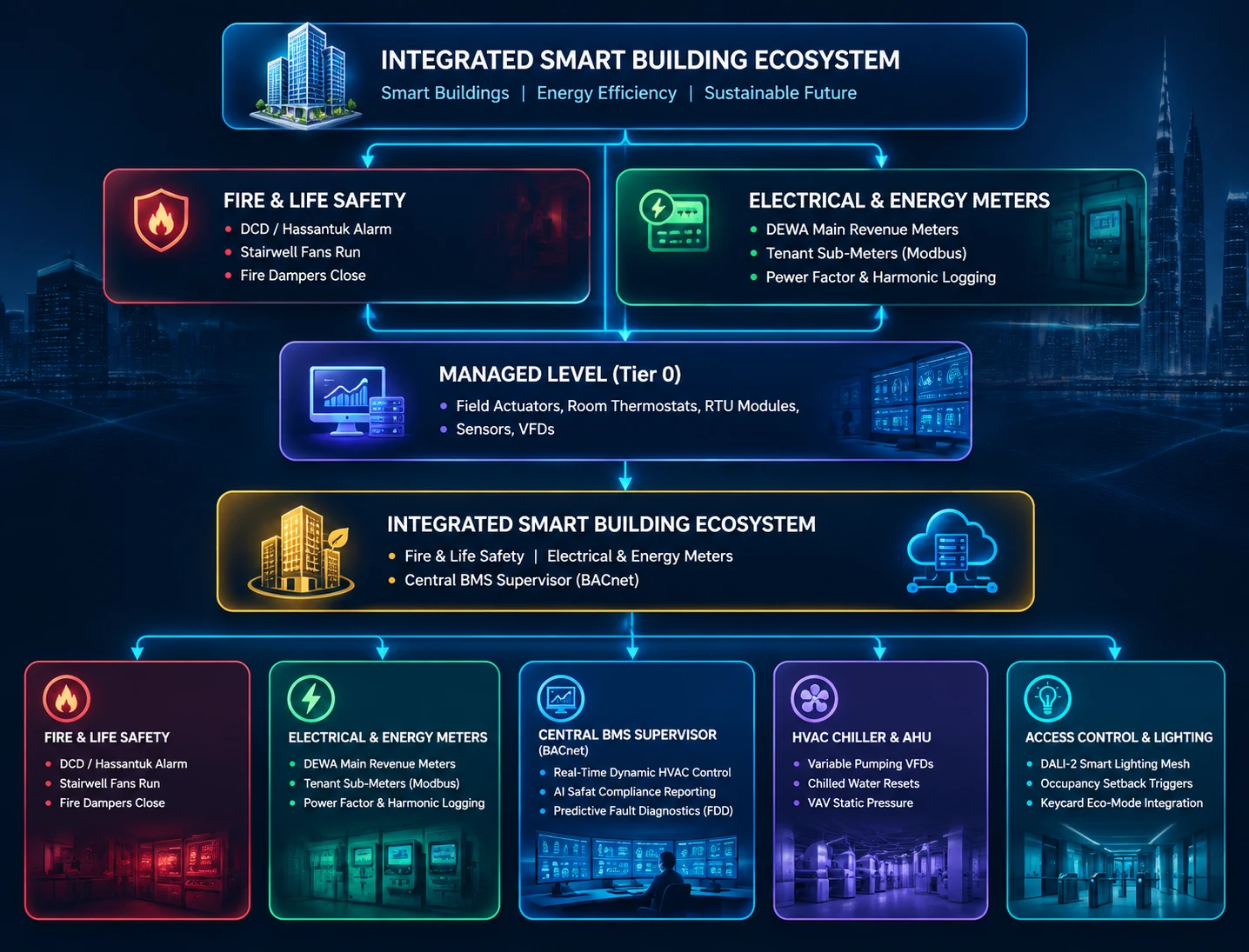
A commercial BMS links with fire alarms, access control, and power meters to satisfy UAE safety codes.
Dubai Civil Defence (DCD) Fire Safety Interface
Under the UAE Fire and Life Safety Code (DCD, 2026), life safety controls always come before cooling comfort. When a fire alarm sounds, the BMS runs safety steps at once:
- Smoke Fan Start: The BMS starts smoke exhaust fans and stairwell fans to keep exit stairs clear of smoke.
- Fire Damper Closure: Motorized fire dampers in ducts close at once to stop flames from spreading.
- Cooling Fan Stop: Air handling fans in the fire zone stop so they do not feed fresh air to the fire.
- Hassantuk Alarm Alerts: The system confirms all emergency signals reach the main control board.
To meet local safety rules, work closely with an approved fire fighting and safety contractor.
Integration with Access Control & Smart Lighting
In smart buildings, the BMS connects to door card readers. When a worker taps their card at a gate, the BMS shifts their floor from eco mode (26°C) to comfort mode (22.5°C). In addition, DALI-2 smart lights turn on. When the office stays empty for 30 minutes at night, the system returns to eco mode on its own.
Financial ROI & Payback Timeline for Dubai Commercial BMS Retrofits
Building owners weigh automation costs against monthly power bill savings.
Investment Benchmarks in Dubai Commercial Buildings
Our site surveys across Business Bay, DIFC, and Sheikh Zayed Road show clear financial metrics.
- Turnkey Retrofit Cost: AED 12 to AED 22 per square foot of cooled floor area.
- Annual Energy Savings: 20% to 35% reduction on central cooling power.
- Simple Payback Period: 1.8 to 3.2 years for typical commercial towers.
The chart below shows the cumulative 5-year financial return for a 20,000 m² (215,000 sq. ft.) commercial office building in Dubai after a BMS energy retrofit.
Financial Summary: 20,000 m² Commercial Building
| Financial Metric | Before BMS Upgrade | After BMS Upgrade | Net Financial Gain |
|---|---|---|---|
| Annual DEWA Power Bill | AED 1,450,000 | AED 1,130,000 | AED 320,000 / year (22% cut) |
| Emergency Repair Costs | AED 85,000 / year | AED 35,000 / year | AED 50,000 / year saved |
| Chiller Efficiency (COP) | 2.85 COP | 3.75 COP | 31.5% efficiency gain |
| Total Turnkey Setup Cost | — | AED 550,000 | Initial one-time cost |
| Simple Capital Payback | — | — | 1.72 Years (approx. 21 months) |
| 5-Year Net Savings | — | — | AED 1,050,000 net profit |
To keep these savings high, property managers should combine automation with a regular MEP annual maintenance contract.
Step-by-Step BMS Testing, Commissioning & Handover Checklist in Dubai
A Building Management System needs careful testing before handover. In the UAE, bad sensor readings cause control errors and early wear on parts.
PowerCraft MEP follows a four-step testing process based on BSRIA BG 29 rules and Dubai Municipality green codes.
- Pre-Commissioning Checks: Check cable lines, RS-485 polarity, and end resistors. Test all digital and analog inputs and outputs. Calibrate heat and humidity sensors against lab tools.
- Functional Tests: Balance chilled water flow and check control valve open times. Test chiller staging steps under 45°C summer load. Verify air volume flow rates on all floors.
- Safety and Code Sign-Off: Test fire alarm trips, damper closure, and smoke fans. Test DEWA power loss and generator startup steps. Verify sub-meter data logging for Al Sa'fat rules.
- Handover and Training: Set up the 3D graphic screen on central PCs. Configure SMS and email alarm alerts. Deliver user manuals and train the site team.
Three Common Commissioning Mistakes in Dubai Projects
- Unshielded Outdoor Sensors: Direct sun on outdoor sensors causes readings 4°C to 8°C higher than true air temperature. Always fit solar shields on outdoor weather sensors.
- Missing Cable Resistors: Leaving out 120-ohm end resistors on BACnet trunks leads to signal loss.
- Over-Tuned Control Gains: Setting gains too high on cooling valves causes rapid opening and closing. This wears out valve motors fast. Always tune loops for smooth action.
For full pre-handover test checklists, see our guide on MEP testing and commissioning before handover.
Conclusion: Lower Utility Costs with Intelligent Building Automation
In Dubai's commercial property market, energy efficiency directly impacts net income and building value. Installing a modern Building Management System compliant with Al Sa'fat rules lets owners and managers cut HVAC power bills by 20% to 35%, prevent sudden equipment breakdowns, and meet all municipal green codes.
Whether you are designing a new commercial project, seeking Dubai Municipality green building approvals, or retrofitting an existing property, PowerCraft MEP Contracting LLC provides complete engineering support. Our certified team delivers turnkey BMS design, DDC programming, BACnet and Modbus integration, chiller optimization, and testing and commissioning across Dubai.
Ready to lower your facility's energy costs and reduce your DEWA bills?
Contact PowerCraft MEP today to schedule a detailed on-site facility audit.
- Automation Engineering: Complete turnkey BMS design, DDC programming, and sensor setup.
- Cooling Optimization: Chiller staging, water resets, and variable pump control.
- Site Surveys: Comprehensive technical inspections and energy audits.
- Authority Approvals: Full Dubai Municipality, DEWA, and DCD compliance support.
FAQ
Need MEP Support in the UAE?
Contact PowerCraft MEP Contracting for electrical, HVAC, plumbing, ELV, fire fighting, fit-out MEP, maintenance, testing, commissioning, and AMC support.


